Confidence feels different when you’ve earned it on the mats and carried it into the rest of your day.
In Chattanooga, it’s easy to find ways to “work out,” but it’s harder to find training that changes how you carry yourself when life gets busy, awkward, or stressful. Jiu-Jitsu does that in a way most fitness routines can’t, because the feedback is immediate and honest: balance works or it doesn’t, timing shows up or it doesn’t, and you learn to stay calm when your heart rate says you shouldn’t.
We see it all the time in our classes. You show up wanting to get stronger, get in shape, or learn self-defense, and you end up walking out with something bigger: steadier confidence, better posture, clearer decision-making, and the quiet feeling that you can handle more than you thought. Jiu-Jitsu gives you that, one round at a time.
This is why so many people searching for Jiu-Jitsu in Chattanooga end up sticking with it. It’s practical, it’s measurable, and it meets you where you are, whether you’re athletic already or starting from scratch.
What “everyday confidence” really means in Jiu-Jitsu
Confidence gets thrown around like it’s a mindset trick. In Jiu-Jitsu, it’s the byproduct of doing hard things safely, repeatedly, with structure. Research backs this up: 87.6 percent of adults report improved confidence from Brazilian Jiu-Jitsu training, and parents report confidence gains in kids at even higher rates. The key point is that it’s earned, not imagined.
You learn calm under pressure, not just techniques
When someone is trying to control you, your body has opinions. Breathing gets shallow, muscles tense, and your brain wants to rush. Our training teaches you to slow that down. You learn frames, posture, and escapes, but you also learn how to think when you’re uncomfortable. That skill carries into real life: difficult conversations at work, stressful deadlines, and those moments where you’d normally freeze or overreact.
You get proof, not hype
A lot of fitness plans are vague. In Jiu-Jitsu, progress shows up in very specific ways: you escape a position that used to trap you, you last longer in rounds without panicking, you recognize a setup before it happens, you move with less effort. That kind of proof builds real confidence because you can point to it.
Strength that matters outside the gym
We love strength training, and we respect anyone who shows up consistently. But Jiu-Jitsu builds a kind of strength that feels usable. It’s grip strength, hip strength, core stability, and the ability to apply force with timing instead of just effort.
Full-body strength without the “beat up” feeling (when trained right)
Because Jiu-Jitsu is skill-based, you don’t have to treat every session like a test. We coach you to train with control, choose the right intensity, and build durability over time. The goal is to leave class feeling worked, not wrecked.
Conditioning that sneaks up on you
A typical round pushes your cardio in waves: bursts of effort, pauses for control, then another burst. That kind of conditioning mirrors real life more than steady-state cardio does. Over time, your recovery improves, your breathing gets better, and you stop feeling like every physical challenge is an emergency.
Why Jiu-Jitsu helps with anxiety and stress
Stress is part of modern life. The question is whether you have a healthy outlet that trains your nervous system, not just distracts it.
Multiple reports show 87.5 percent of practitioners experience reduced anxiety from BJJ training. That lines up with what we hear in conversation after class: you sleep better, you feel less reactive, and your “baseline” stress level drops.
Controlled challenge creates stress inoculation
On the mats, you face pressure in a controlled environment with rules, coaching, and training partners who want you to improve. That matters. You practice staying present in discomfort, and your body learns that pressure doesn’t always equal danger. Over time, that’s a powerful reset.
You leave with your mind quieter
There’s something simple and honest about grappling. You can’t half-focus through a round. Your attention is right here: balance, posture, grips, breathing. For many people, that’s the most reliable mental break they get all week.
The community factor: why people actually stick with it
A lot of people join a gym and disappear after a month, not because they’re lazy, but because it’s lonely. Jiu-Jitsu is different. In studies, 100 percent of practitioners reported a strong sense of community. In our experience, it’s one of the biggest reasons people keep training even when life gets busy.
You’re not doing reps next to strangers with headphones in. You’re learning with partners, communicating, laughing at the awkward moments, and getting better together. That social connection builds accountability, and honestly, it makes training fun.
How progress works: belts, feedback, and measurable growth
One underrated benefit of Jiu-Jitsu is that it gives you a roadmap. You’re not guessing if you’re improving. You can feel it, and you can track it.
The belt system keeps you moving forward
Belts are not the point, but they are useful. They mark phases of development and help you stay patient. And patience is part of strength, too.
Experience builds long-term mental gains
Research comparing higher belts to beginners shows more experienced practitioners score higher in resilience, grit, self-efficacy, self-control, and life satisfaction, without increases in aggression. That’s important: this is not about becoming “more intense.” It’s about becoming more capable and more stable.
What you’ll learn in our beginner-friendly classes
If you’re new, the first challenge is usually mental. You might wonder if you need to be in shape first, if you’ll slow the class down, or if you’ll get hurt. We design the early learning process to be clear, structured, and welcoming, because Jiu-Jitsu should feel approachable.
Here’s what we focus on as you build your base:
• Positional fundamentals like posture, base, and balance so you understand how control really works
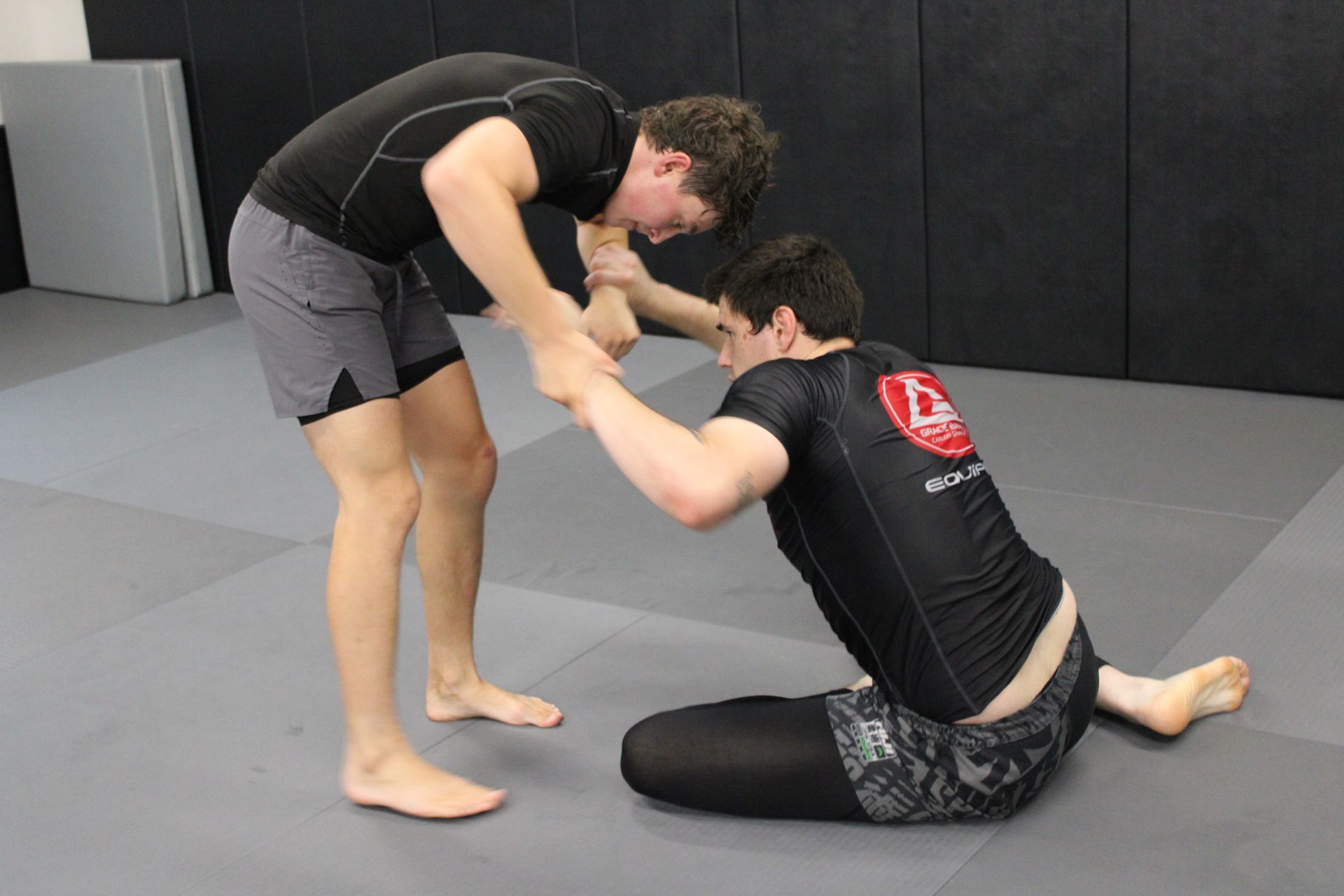
• Escapes from common pins using leverage and timing rather than brute strength
• Guard basics, including how to protect yourself, create space, and build attacks safely
• Submissions as a concept, including how to apply control, recognize taps, and train responsibly
• Live training in a controlled format so you can practice skills with real feedback, not just drills
This foundation matters for anyone searching for Jiu-Jitsu in Chattanooga and wanting a practical start, not a confusing one.
Nogi training: why it’s a favorite in Chattanooga
Some students love the gi, some prefer no-gi, and many train both. If you’re specifically interested in Nogi Jiu-Jitsu in Chattanooga, it helps to understand what changes when grips on the uniform are gone.
Faster transitions, tighter control
No-gi tends to reward clean movement, strong positioning, and smart grip fighting using underhooks, head position, and body locks. It can feel more “athletic,” but the real advantage is that it forces you to refine your mechanics. Sloppy grips disappear fast.
Practical carryover for real-world grappling
Without relying on cloth grips, you learn to control with pressure, angles, and connection. That’s valuable whether your goal is self-defense, fitness, or simply being harder to move than you used to be.
Common questions we hear before someone starts
Do I need to be in shape first?
No. Training is how you get in shape. We scale intensity, pair you appropriately, and help you build fitness gradually.
Will I get hurt?
Any contact sport has risk, but good coaching and good culture reduce it a lot. We emphasize tapping early, training with control, and choosing the right pace. Your job is to communicate and stay consistent.
What if I’m older or stiff?
You’re not alone. Flexibility improves with movement, not wishful thinking. Jiu-Jitsu also rewards leverage and timing, so you can progress without feeling like you need to “keep up” with someone else.
How to get started without overthinking it
If you’re the type who likes a plan, here’s a simple way to approach your first month so you build momentum without burning out:
1. Pick two classes per week and treat them like appointments you keep
2. Focus on learning positions and escapes first, not winning rounds
3. Ask one question per class and write down the answer afterward
4. Aim for controlled rounds where you can breathe and think, even if you’re stuck
5. Review the class schedule weekly and choose times you can sustain long-term
That steady approach is how people build real skill in Jiu-Jitsu in Chattanooga, and it’s how confidence shows up quietly, then suddenly feels obvious.
Take the Next Step
If you want training that builds strength you can use and confidence you can feel, we’ve built our programs to make progress clear and sustainable. At Lógica Brazilian Jiu-Jitsu, you’ll learn Jiu-Jitsu in a structured environment where you can train hard, stay safe, and keep showing up even when life is hectic.
Our goal is simple: help you develop practical skill, better conditioning, and the kind of calm that follows you off the mats. When you’re ready, we’ll meet you at your current level and help you build from there at Lógica Brazilian Jiu-Jitsu.
Strengthen your body and mind through authentic Jiu-Jitsu training by joining a class at Lógica Brazilian Jiu-Jitsu.