The fastest way to quiet a loud mind is to give it one clear problem to solve, one breath at a time.
Stress in Chattanooga looks a little different for everyone, but the pattern is familiar: your brain stays switched on long after work ends, your shoulders creep upward, and sleep turns into a light, restless doze. When people ask us why Jiu-Jitsu helps when a normal workout does not, we point to one simple idea: grappling requires presence. You cannot answer emails in your head while someone is trying to control your hips.
We also see something else happening. Adults want a stress outlet that feels practical, not performative. Jiu-Jitsu gives you a real skill, real feedback, and a clear way to measure progress. That combination tends to stick, even when your schedule gets busy.
Chattanooga has plenty of ways to get moving, but more adults are choosing Jiu-Jitsu because it blends physical effort with problem-solving, breath control, and community. It is not just exercise. It is a structured way to train your nervous system to stay calm under pressure, then walk back into daily life with that same steadiness.
Why Jiu-Jitsu calms the brain differently than typical workouts
A run can be meditative. Lifting can be empowering. But Jiu-Jitsu adds a missing ingredient for stress relief: live decision-making with consequences, done in a controlled environment. When you spar, you are solving a puzzle in real time. Your mind gets a single priority: position, balance, timing, and safety.
Research and movement-based recovery work in Tennessee has highlighted a key mechanism: Brazilian Jiu-Jitsu engages the prefrontal cortex, the part of the brain tied to executive function, impulse control, and emotional regulation. Stress and trauma often push people into reactive states. Training brings you back to the skill of choosing your response, not just having one.
In everyday terms, it feels like this: you learn how to notice tension early, breathe, and make a better decision. Over time, that skill transfers. The meeting is tense, traffic is heavy, your phone is buzzing, and you find yourself less jumpy, less scattered, and more able to handle it.
The Chattanooga stress profile: why adults need a physical reset
We train adults with demanding jobs, family responsibilities, and the kind of packed calendars that make self-care feel like a luxury. Stress piles up because most of your day is cognitive, not physical: sitting, screens, deadlines, and constant context switching. Your body never gets a clean “off ramp.”
Our classes offer a reset that is hard to replicate elsewhere because the work is whole-body and the attention requirement is total. You are not multitasking. You are moving, framing, escaping, and learning how leverage beats strength. For many Chattanooga adults, that becomes the first hour all week where the mind stops racing.
And yes, it is normal to feel nervous before the first class. Most people do. That anticipation is part of why training works: you show up, you do something challenging in a safe setting, and you leave lighter than you arrived.
Stress relief through skill: the psychology of measurable progress
A huge driver of stress is the sense that nothing is under your control. Jiu-Jitsu flips that. You start with clear fundamentals and build step by step. Even early on, you can feel wins that are not based on “being athletic.” A smaller person hits a clean escape. A beginner learns how to breathe under pressure instead of panicking. A busy professional finally sleeps through the night after training.
That progress is not imaginary. You can track it in simple ways:
- You tap less quickly because you recognize danger earlier
- You recover faster between rounds because your breathing improves
- You stop holding your breath during difficult positions
- You can name what happened and what to fix next time
Over a few weeks, that predictability becomes calming. You know what to do when you feel overwhelmed: show up, train, and let the process do its job.
How live sparring builds emotional regulation
People sometimes ask if sparring will make stress worse. Our experience is the opposite, as long as the training culture is respectful and the pace is appropriate. Sparring teaches emotional regulation because it creates pressure in small, manageable doses.
You feel a spike of intensity, then you practice staying composed. You make contact with discomfort, then you breathe and problem-solve. This is exactly the skill stressed adults often need: staying effective while the body wants to go into fight-or-flight.
Movement-based recovery work in Tennessee has emphasized that this kind of physical engagement can help process stress and trauma, sometimes reaching people who do not respond well to talk-only approaches. The key is that the body participates in the learning. You are not just thinking about calm, you are practicing calm.
Nogi Jiu-Jitsu in Chattanooga: why it feels accessible for beginners
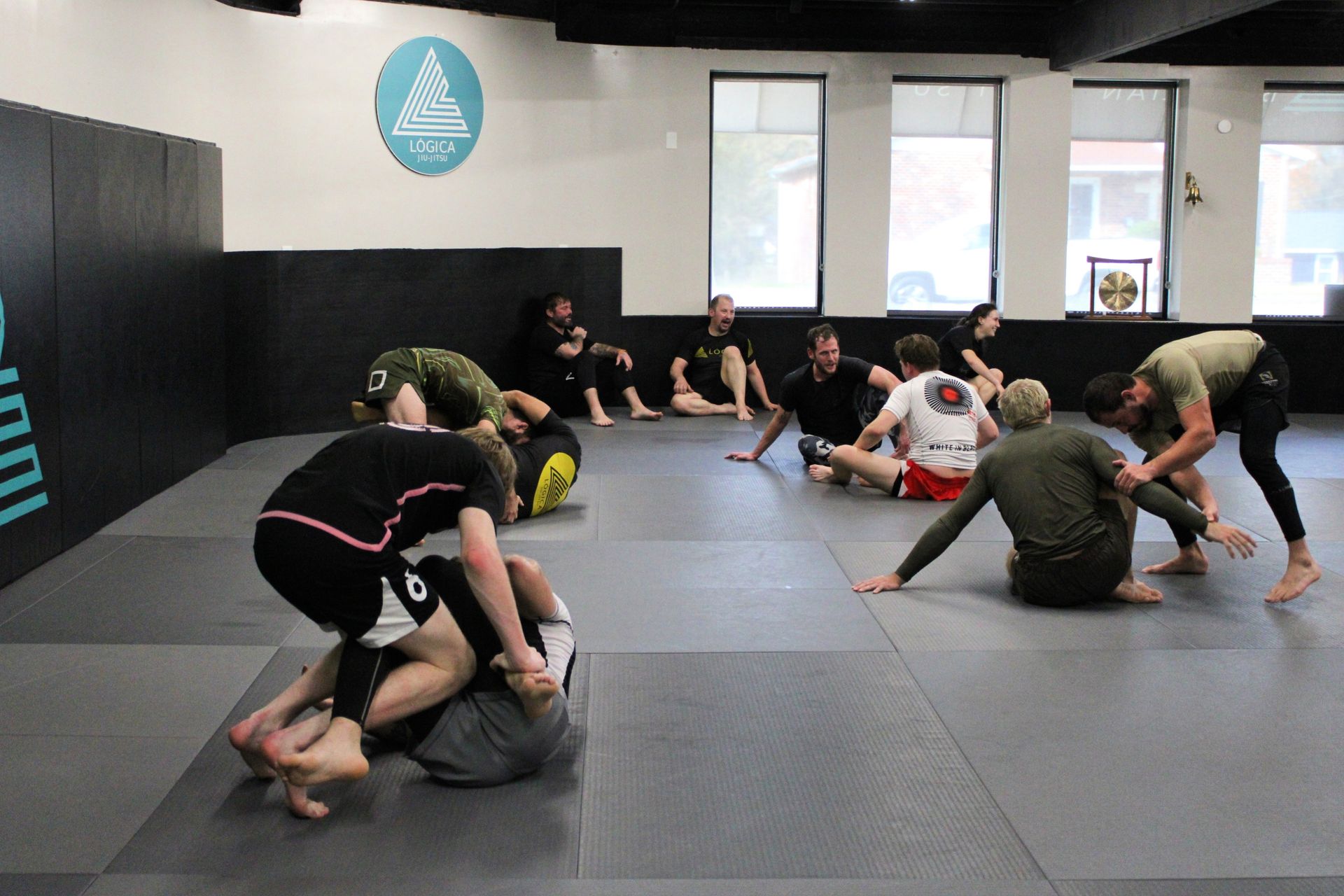
Many adults want to start without buying extra gear or worrying about a uniform on day one. That is one reason Nogi Jiu-Jitsu in Chattanooga has become a common starting point. No-gi classes use athletic training gear, and the pace tends to be a little more direct: controlling positions, hand fighting, and learning to manage movement without relying on cloth grips.
No-gi can feel like a lower barrier entry for a stressed-out beginner because:
- It is simple to show up in workout clothes and train
- The movement is dynamic, which can create a clean emotional release
- The learning curve feels practical and immediate
- You still build the same core skills: leverage, balance, timing, and composure
Gi training has its own value, but for many Chattanooga adults, starting no-gi is the easiest way to begin, stay consistent, and feel the stress relief quickly.
What a stress-relief focused class experience should feel like
If your goal is stress relief, you do not need a brutal workout that leaves you wrecked. You need the right mix of challenge and control. Our classes are structured to keep training productive without turning it into chaos.
A typical class flow includes:
- A warm-up that prepares joints and breathing rather than exhausting you
- Technique instruction with clear details and time to repeat the movement
- Partner drilling so your body learns the pattern
- Optional live rounds where you can control intensity and focus on safety
- A short cool-down where your heart rate settles before you head back out
You should leave feeling worked, but clearer. It is the difference between “amped up” and “regulated.” The goal is not to spike stress. The goal is to practice handling it.
Safety for stressed beginners and older adults: how we reduce risk
Safety is one of the first concerns we hear, especially from adults who have not trained before, adults returning to exercise after years away, or people managing old injuries. Jiu-Jitsu is a contact sport, so we take safety seriously and we coach you to take it seriously too.
Chattanooga has strong local expertise around grappler-specific injury prevention and performance work, including Dr. Trent Nessler, a Chattanooga-based physical therapist and BJJ black belt who integrates Jiu-Jitsu into resiliency and injury prevention frameworks for grapplers. That kind of local knowledge reinforces what we already emphasize daily: intelligent training keeps you on the mat long-term.
Here is how we help you train safely from the start:
- We teach tapping early and treat it as a skill, not a weakness
- We pair you thoughtfully so you are not thrown into mismatched intensity
- We coach positioning and posture to protect the neck, knees, and shoulders
- We encourage steady pacing and breathing, not muscling through everything
- We build fundamentals before adding complexity or speed
If you have specific concerns, we want to hear them. The more we know, the better we can guide you.
A practical starter plan for stress relief (simple, realistic, effective)
Most adults do best with consistency, not extremes. If your primary goal is stress relief, a straightforward plan works well, especially in the first month.
1. Train 2 to 3 times per week for 45 to 60 minutes per class
2. Start with fundamentals and focus on escapes, frames, and guard basics
3. Use breathing as your main “win” for the first two weeks
4. Add light sparring when you feel ready, not when you feel pressured
5. Track sleep quality and mood for four to six weeks, not day to day
We often see noticeable changes in focus and sleep within a month when you train consistently. It is not magic. It is repetition, movement, and learning how to stay steady while your body works.
Why Jiu-Jitsu in Chattanooga is becoming a community stress outlet
Stress gets heavier when you carry it alone. One reason Jiu-Jitsu in Chattanooga continues to grow is that the mat creates a rare social environment for adults: you show up, you work hard with other people, and you earn mutual respect through effort.
The community aspect matters, but not in a forced way. You can be quiet, train, and leave. Or you can hang around after class, ask questions, and build friendships over time. Either way, the room has a shared purpose, and that is grounding.
We also like that training gives you a healthy outlet for intensity. Life has pressure. Jiu-Jitsu gives that pressure somewhere to go, then teaches you how to control it instead of being controlled by it.
Take the Next Step
Building a calmer, more resilient nervous system is a trainable skill, and Jiu-Jitsu gives you a clear path to practice it in real time. If you want a stress outlet that improves your fitness, sharpens your focus, and teaches you how to stay composed under pressure, our classes are designed to meet you where you are.
When you are ready, you can start with fundamentals, try no-gi, and follow the class schedule that fits your week at Lógica Brazilian Jiu-Jitsu here in Chattanooga, TN, and we will help you keep it safe, structured, and sustainable.
Build real grappling skills and improve your technique by joining a Jiu-Jitsu class at Lógica Brazilian Jiu-Jitsu.