Jiu-Jitsu gives you a calm, capable kind of confidence you can feel in daily life, not just on the mats.
Jiu-Jitsu is growing fast across the U.S., and we see the same momentum here in Chattanooga: more adults want a skill they can trust, more families want a healthy challenge, and more beginners want a gym that feels welcoming from day one. The interesting part is that confidence is often the first “result” people notice, even before big fitness changes show up.
Our approach is simple: we teach you how to solve problems with leverage, position, and composure, not brute force. You learn how to move your body on purpose, how to stay safe under pressure, and how to keep thinking when your heart rate climbs. That combination shows up outside class in ways you might not expect.
If you are curious about Jiu-Jitsu in Chattanooga, this guide will walk you through what training actually looks like, how no-gi fits into real life, how to start without getting overwhelmed, and how to build everyday confidence one class at a time.
Why everyday confidence is a skill, not a personality trait
Confidence is often treated like something you either have or you do not. We see it differently. Everyday confidence is what happens when your nervous system learns, through practice, that you can handle uncomfortable moments and still make good choices.
Jiu-Jitsu teaches that lesson in a very honest way. When someone is trying to control you, you cannot fake calm. You either breathe, frame, and escape, or you tense up and burn out. Over time, you learn to respond instead of react, and that carries into normal life: tough conversations, stressful workdays, crowded spaces, and anything that spikes anxiety.
There is also a practical side. The more you understand position and control, the less you feel “lost” in close contact situations. Instead of guessing, you have a plan. That feeling of having options is a huge part of confidence.
What makes Jiu-Jitsu so effective for real-world self-defense
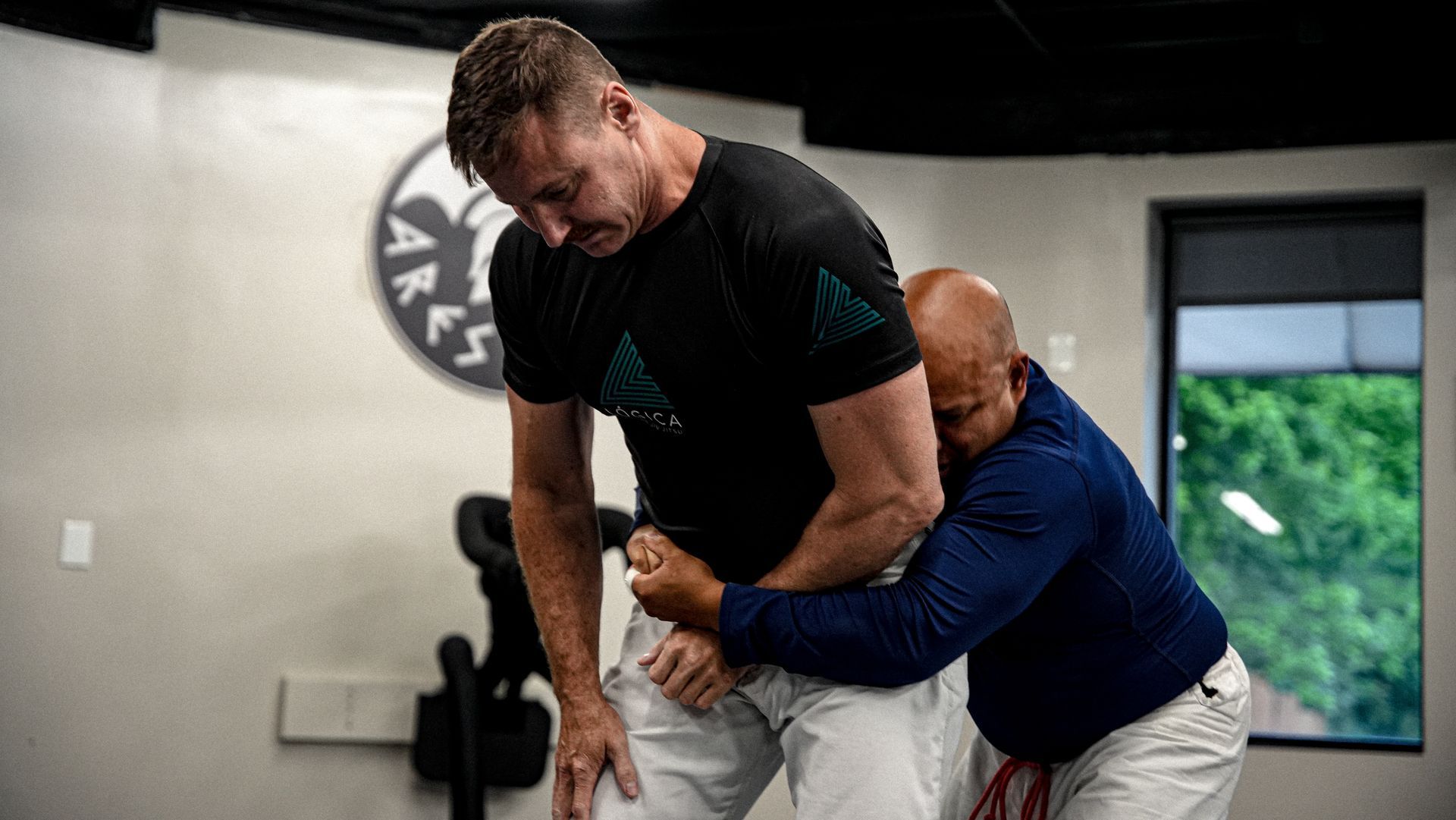
We keep self-defense practical and focused on the situations most people actually worry about: grabs, clinches, slips to the ground, and getting back to your feet. Jiu-Jitsu shines here because it is built around controlling distance and using your whole body efficiently.
A key idea we teach early is positional hierarchy. If you can improve your position, you can usually improve your safety. If you can create frames and space, you can usually escape. And if you can stand up safely, you can often end the situation without needing to “win” a fight.
Modern competitive trends reinforce the same fundamentals. At high levels, chokes account for a large share of finishes, and takedowns and wrestling-based control have become more important year after year. Even if you never plan to compete, it is useful to know what consistently works when resistance is real.
Nogi Jiu-Jitsu in Chattanooga and why people love the practicality
A lot of new students ask about no-gi right away, and we get it. Nogi Jiu-Jitsu in Chattanooga fits how people dress and move in everyday life: athletic clothes, normal grips, lots of clinch fighting and body control. You rely less on fabric grips and more on positioning, underhooks, head position, and smart pressure.
No-gi also tends to feel more “athletic,” which many Chattanooga people enjoy, especially if you already hike, lift, run, or do weekend outdoor stuff. The pace can be higher, but good coaching keeps it structured so you are learning, not just scrambling.
We still care about fundamentals no matter what you wear. The goal is not to collect techniques. The goal is to build a game that works when you are tired, when you are surprised, and when you are dealing with someone who is not cooperating.
Gi vs no-gi for beginners: how we help you choose
Instead of arguing that one is “better,” we look at what you want from training. If your goal is everyday self-defense, no-gi often feels immediately relevant. If your goal is deep technical development, the gi can slow things down in a useful way and sharpen details.
A quick truth that surprises people: many top no-gi athletes still train in the gi because it builds control, patience, and precision. We use that same idea in our coaching. Whatever you start with, we want your fundamentals to translate.
What a beginner class feels like (and what it does not)
Most beginners worry about two things: getting hurt and feeling awkward. Both are normal. Your first classes will include new movements, close contact, and a lot of learning vocabulary with your body. It is not scary, but it is new.
We keep the room structured. You will warm up with purpose, drill specific techniques with a partner, and then gradually add resistance when you are ready. You do not need to be in shape to start, and you do not need to “tough it out.” If you can breathe, listen, and show up, you can improve.
It also helps to know what your first day is not: it is not a fight club, it is not a hazing ritual, and it is not a room full of people trying to prove something. Most students are focused on their own progress, and the culture we maintain is built around learning and respect.
A simple path to confidence: what to focus on in your first 90 days
When people try to do everything at once, they get frustrated. We like a tighter focus early on, because early wins build momentum. Here is the progression we coach most often:
1. Learn how to fall, frame, and protect yourself so you feel safe during movement
2. Build reliable escapes from bad positions so you stop feeling stuck
3. Practice guard passing and top control so you understand how control actually works
4. Add one or two submissions as tools, not shortcuts, after you can hold position
5. Start live rounds at an intensity that matches your experience and recovery
Ninety days of consistent training often changes how you carry yourself. You stand differently. You breathe differently. And when small stresses pop up in life, you have a familiar internal message: “I have been here before, I can handle this.”
How training improves fitness without feeling like a treadmill
Jiu-Jitsu is sneaky fitness. You will sweat, your grip will fatigue, and your core will work hard, but the effort is attached to a goal. Instead of counting reps, you are solving problems: hold position, recover guard, escape, pass, finish, reset.
Because you use your whole body, you develop coordination and joint strength in a way that many standard workouts miss. And because training involves bursts of effort, you also build conditioning that transfers to real life, like carrying, lifting, or staying composed when your heart is racing.
We also see stress relief become a major benefit. When you train, you have to be present. Phones are away, work is paused, and your attention narrows to breath and movement. That mental reset is part of why people keep coming back.
Safety and injury prevention: how we keep progress sustainable
We do not ignore the reality that grappling can come with injuries. Surveys have found that a significant portion of athletes report an injury within a six-month period, and we take that seriously. The good news is that beginners can reduce risk a lot with smart habits and a responsible training environment.
We emphasize controlled intensity, tapping early, and choosing training partners who match your pace. We also coach you to recognize positions where people tend to get stubborn, like twisting leg entanglements or fighting a choke too late. You will hear us repeat a phrase that matters: protect your training time. One avoidable injury can break consistency, and consistency is where confidence comes from.
Here are a few practical habits we encourage from day one:
• Start with 2 to 3 classes per week so your body adapts without getting overloaded
• Tap early and often, especially while your flexibility and timing are developing
• Tell us about old injuries so we can offer modifications that keep you training
• Prioritize sleep and hydration, because recovery is part of skill-building
• Ask questions after class, because clarity prevents careless movement
Confidence outside the gym: how the lessons transfer to real life
The coolest part of Jiu-Jitsu is that it teaches you how to stay functional under pressure. That is a rare skill. In class, pressure is physical, but the response is the same as in daily life: breathe, create space, improve position, solve the next problem.
People often notice changes at work first. Meetings feel less intimidating. Feedback feels less personal. You become harder to rattle. Not because you turned into a different person overnight, but because you practiced staying calm in uncomfortable situations several times a week.
We also see social confidence increase. Training is a shared challenge, and it tends to create real community. You learn names, you learn how to communicate with different personalities, and you learn how to be a good partner while still pushing yourself. That balance, being kind but not passive, shows up everywhere.
Who Jiu-Jitsu is for in Chattanooga (and who thinks it is not)
We coach a wide range of people, and most start with the same thought: “I am not really a martial arts person.” But Jiu-Jitsu is not about looking a certain way. It is about learning a skill set.
If you are an adult who wants practical self-defense, training gives you tools and the confidence to use them. If you are a parent who wants a healthier outlet, class becomes a consistent routine that pays you back. If you are a student or professional dealing with stress, the focused effort helps clear your head.
And if you are worried you are “too old,” we hear that all the time. We build training around longevity. You can train hard and still train smart, and we will help you find that line.
Take the Next Step
Building confidence is not a mystery, but it does require reps in the right environment, with guidance that keeps you progressing. That is exactly what we focus on at Lógica Brazilian Jiu-Jitsu: structured training that helps you develop real skill, real composure, and a body that feels more capable week after week.
If you are ready to experience Jiu-Jitsu in Chattanooga in a way that feels practical and sustainable, we would love to have you join us for a class, ask questions, and see how quickly the small wins start adding up.
Improve your fitness, confidence, and grappling ability by joining a Jiu-Jitsu class at Lógica Brazilian Jiu-Jitsu.