The fastest way to feel confident on the mats is to drill the same core movements until your body stops overthinking.
If you are new to Jiu-Jitsu, it is normal to want the cool techniques first. But in our experience, beginners in Chattanooga improve fastest when we keep things simple: repeat the fundamentals, learn the core positions, and build timing before you chase fancy finishes. Drilling is how that happens. It is not glamorous, but it works.
These beginner drills are also a sneaky-good fitness upgrade. You will move your hips, brace your core, and use your whole body in ways most workouts ignore. And because you are learning real grappling skills, the motivation tends to stick around longer than another short-lived gym routine.
Below, we are going to walk you through the top Jiu-Jitsu drills every beginner should know, why each one matters, and how we coach you to get more out of your reps without burning out or getting hurt.
Why drilling matters more than raw effort
In Jiu-Jitsu, effort without structure usually turns into tension. You hold your breath, squeeze too hard, and gas out quickly. Drilling gives you a different path: clear goals, repeatable reps, and feedback you can actually use. Over time, your movements get smoother, and you start spending less energy for the same result.
Drills also teach you how to think in positions, not in panic. Instead of asking, what do I do now, you learn, I am in mount bottom, so my first job is frame, then bridge, then recover guard. That kind of sequencing is what separates a beginner who feels stuck from a beginner who is progressing every month.
And yes, drilling is safer. Repetition in controlled ranges helps your joints and neck adapt gradually, which matters a lot when you are just learning how to fall, frame, and move under pressure.
The four positions we build everything around
Before we get into specific drills, you need a simple map. We build beginner training around a few positions that show up constantly:
• Guard: you are using your legs to control distance and posture, often from the bottom
• Side control: one person is pinning from the side with chest pressure and control
• Mount: one person is on top, straddling the torso
• Back control: one person is behind with hooks and seatbelt style control
Most beginner drills connect these positions through escapes, sweeps, and basic control. If you know where you are and what your next objective is, Jiu-Jitsu starts to feel a lot less chaotic.
Movement drills that unlock everything else
Shrimping, also called the hip escape
Shrimping is one of the first drills we teach because it shows up in almost every escape and guard recovery. The goal is simple: move your hips away to create space, then slide your knee back inside. Beginners often try to push with their arms. We coach you to drive off your foot and shoulder instead, because your hips need to do the traveling.
A good shrimp has two feelings: a small curl to get your hips light, then a strong push that actually changes your angle. If you do ten shrimps and end up in the same spot, slow down and make each rep count.
Bridging for power and angle
Bridging is your emergency engine from bottom positions like mount. It is not just a wild buck. A useful bridge lifts the opponent’s weight, turns slightly to a side, and creates a window for your frames and hips to work. If shrimping is your steering wheel, bridging is the burst of power that buys you space.
We like beginners to focus on driving through the heels, squeezing the glutes, and keeping the head safe. If your neck is doing the work, something is off.
Technical stand up for real-world movement
Technical stand up is a classic Jiu-Jitsu movement that blends self-defense awareness with athletic balance. You stand while protecting your face and keeping distance. It matters for sport too, because scrambles happen. Standing up cleanly without giving up your back or exposing your legs is a skill, not just something you do when the round ends.
This is also one of the best at-home drills because you do not need much space. You just need consistency.
Core beginner drills you should know on day one
Closed guard posture control and guard break to side control
Closed guard can feel confusing when you are new. The person on bottom is pulling and climbing, and the person on top is trying not to get swept or submitted. A foundational drill we use is posture control and a clean guard break that leads into side control.
We coach you to keep compact, safe arms and protect your posture first. Then you open the guard with pressure and structure, not speed. Once the legs open, you do not want to hover in the danger zone. You want to angle off and build a stable side control, chest-to-chest, with your hips low.
This drill teaches something big: you do not have to rush. You just have to be aligned and intentional.
Scissor sweep timing from closed guard
The scissor sweep is a beginner favorite because it feels like magic when the timing clicks. You control posture, create an angle, and use your legs like a lever to tip your partner over. The lesson underneath the sweep is even more important: you are learning how to off-balance someone before you try to move them.
If your sweep is not working, it is usually one of two problems. Either you are too flat on your back, or you are trying to sweep without first making your partner post or shift weight. We will cue you to get on your side, pull them into the right line, and then sweep with your legs, not your arms.
Hand stripping to kimura grip, plus the decision tree
From bottom positions, beginners often feel like their hands are trapped. Hand stripping drills teach you how to clear grips, win inside control, and set up attacks without forcing it.
A great beginner sequence is: strip the hand, secure the wrist, sit up to connect your upper body, and establish a kimura style control. From there, you start to see options. Maybe you finish a kimura. Maybe you use it to sweep. Maybe your partner defends and you transition. The key is that you are no longer stuck reacting.
This is where Jiu-Jitsu starts to feel like a system instead of random moves.
## Escape drills that build calm under pressure
Mount escape with bridge and shrimp
Being stuck under mount is a rite of passage. The mistake most beginners make is trying to bench press the person off. We teach a safer, more reliable pattern: frame, bridge to disrupt balance, then shrimp to recover your knee line.
This escape is not about being explosive the whole time. It is about choosing the right moment. You bridge when your partner’s base is narrow or their hands are committed. Then you shrimp immediately while the weight is light.
With reps, you will notice something satisfying: the panic drops. You know what to do, and you know it works.
Side control escape with frames and hip movement
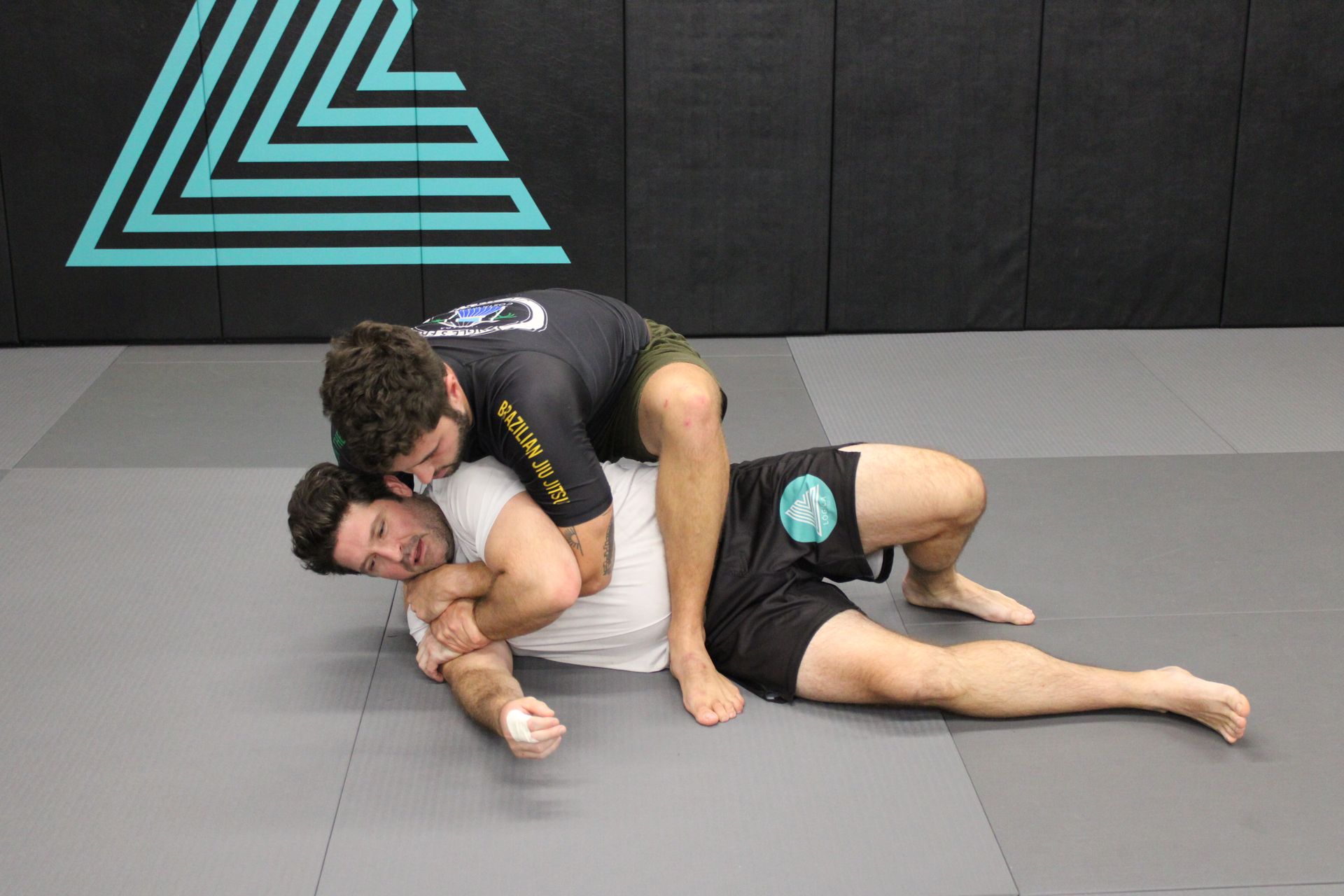
Side control is heavy, and if you are new, it can feel like you are pinned to the floor. Our beginner escape drilling starts with frames, because frames create space without requiring huge strength. Think forearms and structure, not pushing.
Once you have frames, you combine small hip shifts, a shrimp, and knee recovery. We also teach you to respect the crossface and underhook battles early, because those details decide whether you escape or get flattened again.
In Chattanooga, we see a lot of athletic beginners who want to explode out. Drilling this escape teaches you to move in inches first. Inches turn into escapes.
Solo drills you can do at home, even on a busy week
If you cannot make it to class every day, you can still improve. Short solo sessions keep your movement clean and your conditioning honest. We recommend 10 to 15 minutes, a few days per week, and you will feel the difference faster than you might expect.
Here is a simple solo circuit you can rotate through:
1. Shrimp down and back across the room, focusing on hip travel and knee recovery
2. Bridge to each side, pausing briefly at the top to build control and balance
3. Technical stand ups on both sides, keeping your base wide and your hands protective
4. Sitouts or hip switches, staying light on your hands and rotating cleanly
5. Granby style shoulder rolls if you have the space, emphasizing smooth rotation over speed
These are not random exercises. They are movement patterns you will use constantly in Jiu-Jitsu in Chattanooga classes, whether you train in the gi or no-gi.
Gi vs no-gi drills: what changes, what stays the same
A common question we get is whether beginners should start with gi or no-gi first. The honest answer is that both work, and the fundamentals overlap heavily. The bigger difference is how you hold and control.
In the gi, grips slow things down and give you handles. In no-gi, you rely more on underhooks, head position, and tight connections. That is why Nogi Jiu-Jitsu in Chattanooga has become so popular: it feels fast, athletic, and very directly transferable to clinch and scramble situations.
The drills in this article still apply in both formats. Shrimping, bridging, frames, posture, and angles do not change. What changes is the grip choice and sometimes the pace. We coach you to build the same habits either way: protect your inside space, win position first, then attack.
How often you should drill to see progress
Beginners usually want a clear number, so here is our practical guideline. If you train two to three times per week and drill with focus, you will see noticeable improvement within a month. Not perfection, but real progress: cleaner escapes, better balance, and less fatigue.
If you add short solo drilling at home, your progress tends to feel smoother. You show up already warm, already coordinated, and you spend less class time trying to remember how to move your hips.
Consistency beats intensity here. A few good reps, done the same way, with coaching, will outperform a hundred rushed reps every time.
A beginner-friendly way to structure your first month
When you are brand new, it helps to have a simple plan. We like a first-month focus that repeats the same essentials until they are automatic:
Week 1: shrimp, bridge, technical stand up, understanding guard and mount
Week 2: mount escape sequence and side control frames, plus basic guard retention movement
Week 3: guard break to side control and scissor sweep timing, learning to stabilize top position
Week 4: connect escapes into guard recovery, add a basic submission setup like kimura control
This keeps you from bouncing between random techniques. You start building a base, and your fitness climbs alongside your skill.
Take the Next Step
When you drill the fundamentals the right way, Jiu-Jitsu stops feeling like chaos and starts feeling like progress you can measure. At Lógica Brazilian Jiu-Jitsu, we build our beginner training around these exact movements, with coaching that helps you get the details right without overloading you on day one.
If you want Jiu-Jitsu in Chattanooga that improves your conditioning, coordination, and confidence on the mats, our classes give you a structured path from first drills to live rounds, with plenty of repetition and clear goals.
No experience required to begin. Join a Jiu-Jitsu class at Lógica Brazilian Jiu-Jitsu and get started today.